This Week’s SafeSchools Minute
Reporting Suspicious Behavior
Part of the Guided Weekly School Safety Program
How to Use This Week’s Reminder
Share this week's SafeSchools Minute with your staff through your school's usual communication channels.
Use the Ready-to-Send Email below to quickly copy and paste a message into your email, then attach the Reminder PDF before sending.
Each reminder takes about one minute to read and reinforces an important everyday school safety habit.
Included with this Reminder
-
Subject: This Week’s Safety Reminder: Reporting Suspicious Behavior
Staff,
This week’s SafeSchools Minute™ focuses on reporting suspicious behavior.
Suspicious behavior does not always look dramatic or immediately dangerous. It may include someone attempting to enter through an unauthorized door, testing door handles, watching entrances, avoiding staff, photographing restricted areas, or asking unusual questions about school procedures.
You are not expected to investigate the situation on your own. Maintain a safe distance and report the concern immediately through our established school procedure.
When making a report, provide specific facts whenever possible, including the person’s location, appearance, actions, direction of travel, and any vehicle information. Focus on what you directly observed rather than making assumptions about the person’s intentions.
Please take one minute to review the attached reminder.
A concern does not need to be proven before it is reported.
Thank you for remaining alert and helping us address potential concerns before they become larger problems.
-
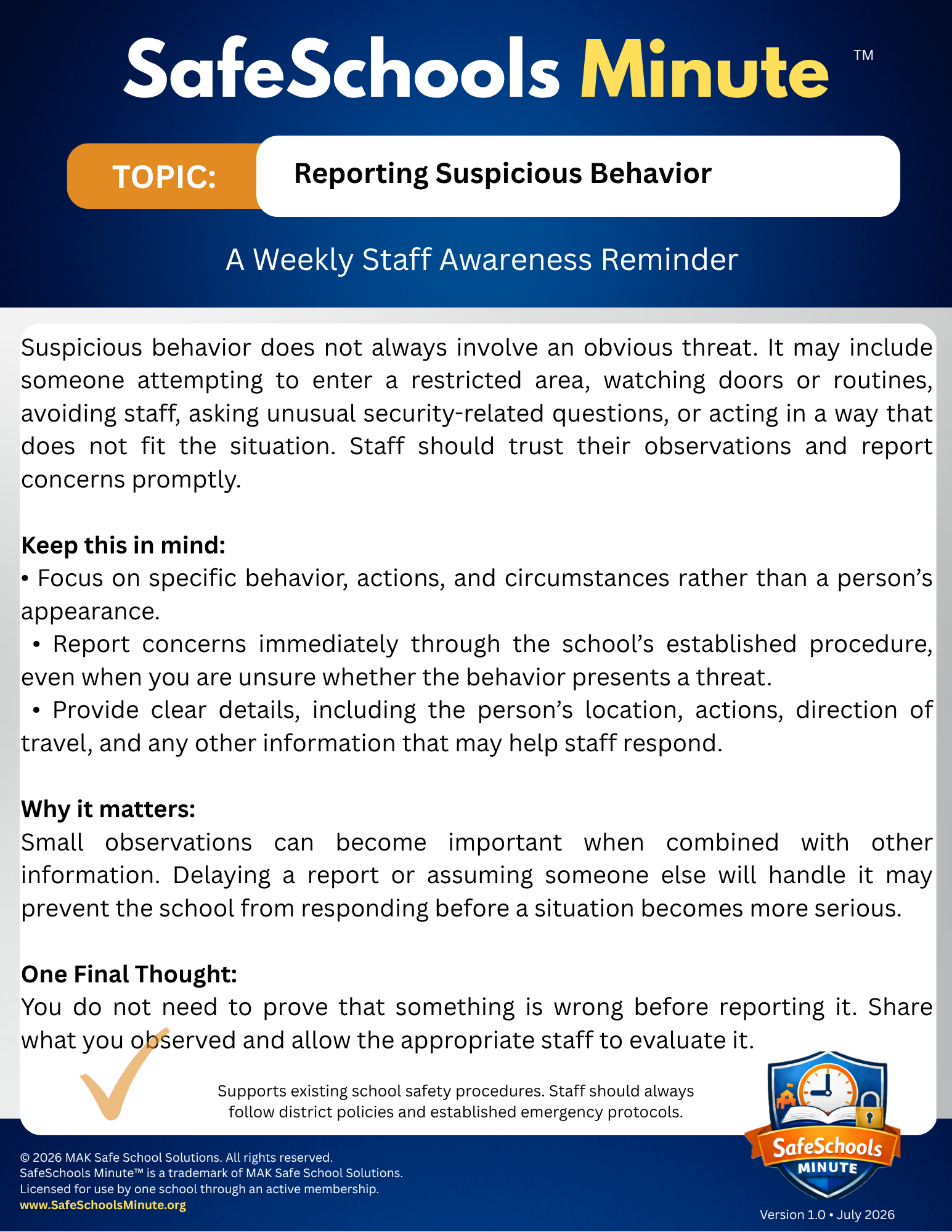
Suspicious behavior does not always look dramatic or immediately dangerous. It may be a person attempting to enter a restricted area, watching entrances, avoiding staff, asking unusual questions, testing door handles, photographing security features, or behaving in a way that does not fit the setting.
Staff members are not expected to investigate suspicious behavior on their own. The priority is to observe, maintain a safe distance, and report the concern immediately through the school’s established procedure.
Report what you actually observed, including the person’s location, appearance, actions, direction of travel, and any vehicle information. Avoid assumptions or labels.
A concern does not need to be proven before it is reported.
-
What information should you include when reporting suspicious behavior?
Suggested response:
Provide specific facts, including:
• The exact location
• What the person is doing
• A clear physical description
• Clothing or distinguishing features
• Direction of travel
• Vehicle description and license plate, when safely visible
• Whether the person has access to students or secured areas -
Pay attention to behavior such as:
• Attempting to enter through a secured or unauthorized door
• Following staff or students into the building
• Testing door handles or gates
• Watching entrances, dismissal areas, or student activity for an unusual length of time
• Photographing security equipment, access points, or restricted areas
• Asking detailed questions about schedules, staffing, or security procedures
• Avoiding staff contact or leaving quickly when approached
• Remaining in an area without a clear reasonFocus on behavior and circumstances, not a person’s appearance alone.
-
This week, practice describing suspicious behavior using specific facts rather than conclusions.
Instead of saying, “That person looked suspicious,” be prepared to explain:
• Where the person was
• What the person did
• What made the activity unusual
• Where the person went nextClear observations help school leaders and emergency personnel respond appropriately.