This Week’s SafeSchools Minute
Knowing Your Emergency Exits
Part of the Guided Weekly School Safety Program
How to Use This Week’s Reminder
Share this week's SafeSchools Minute with your staff through your school's usual communication channels.
Use the Ready-to-Send Email below to quickly copy and paste a message into your email, then attach the Reminder PDF before sending.
Each reminder takes about one minute to read and reinforces an important everyday school safety habit..
Included with this Reminder
-
Subject: This Week’s Safety Reminder: Knowing Your Emergency Exits
Staff,
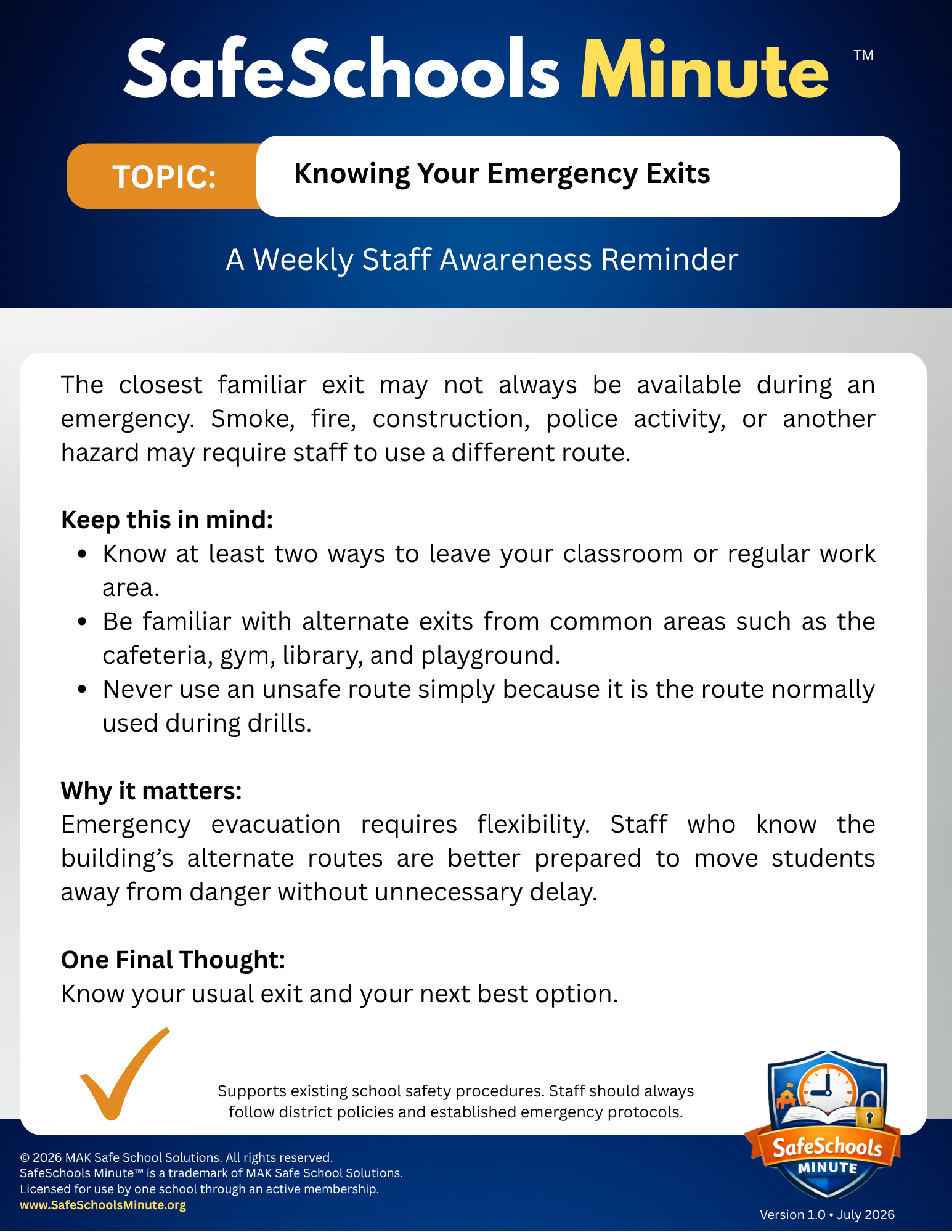
This week’s SafeSchools Minute™ focuses on knowing your emergency exits.
The usual exit may be blocked by smoke, fire, construction, police activity, or another hazard. Staff should know an alternate route from classrooms and commonly used spaces.
This week, please identify at least two evacuation routes from your regular work area.
Please take a minute to review the attached reminder.
Know your usual exit and your next best option.
Thank you for helping us maintain consistent safety practices throughout our school.
-
Knowing your emergency exits means more than knowing the route used during a routine fire drill.
In an actual emergency, the normal exit may be blocked by smoke, fire, debris, police activity, construction, or another hazard. Staff should know both the primary and alternate evacuation routes from the areas they use most often.
This includes classrooms, offices, cafeterias, gyms, libraries, playgrounds, and other shared spaces.
The goal is to avoid hesitation. If one route is unavailable, staff should already have another safe option in mind.
-
If your normal evacuation route were blocked right now, where would you go instead?
Suggested response:
Identify the nearest safe alternate exit and the route you would take to reach it.
Staff should also consider:
• Whether the alternate route is accessible
• Whether it passes through another hazard area
• Whether students can move through it safely
• Where the group would assemble once outside -
Pay particular attention to:
• Exit doors that are blocked or difficult to open
• Hallways or stairwells obstructed by equipment or storage
• Staff who are unsure of alternate routes
• Areas where only one exit is commonly used
• Doors or gates that may be locked when they should be available for emergency egress
• Shared spaces where evacuation routes differ from classroom routesKnowing a route is only useful if that route remains accessible.
-
Take a few moments this week to identify both your primary and alternate emergency exits from the areas you use most often.
Ask yourself:
• What is my first exit?
• What is my backup if that route is blocked?
• Can I reach both routes quickly?
• Would my students or group know where to follow me?If you work in multiple areas during the day, repeat the same check in each location.
Know your usual exit, and know your next best option.